Assessment · for teachers and curriculum leads

Assessing for subject mastery and knowledge.

Project work is assessed on what students produce and how they think. Every project comes with the criteria, rubrics and a checkpoint tracker, so the evidence a curriculum lead needs is built up as you teach, in your own systems.
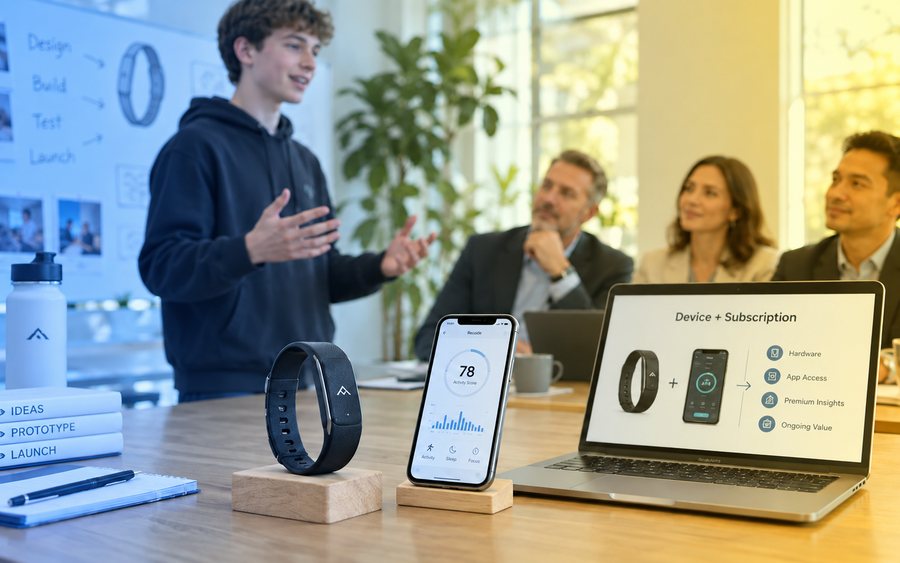
Students pitching to a panel with a laptop showing a business model
The model

Four parts. Every project. Every year.

The same four-part framework runs across all 32 projects, so a Year 8 judgement and a Year 11 judgement mean the same thing and progress can be tracked across four years. Checkpoints during the project are formative; the showcase judgement at the end is summative.

35%
Real deliverable
The product, venture, campaign, prototype or design itself: the largest share, because the real work matters most.
25%
Pitch / presentation + Q&A
A live pitch, demonstration or exhibition to an audience or panel, including handling questions with composure.
20%
Real-world / user evidence
Proof it works with real people: user validation, pilot results, trading figures, reach and impact data.
20%
Project / design journal
Reflection and process across the project: how students thought, adapted and grew. Individual, even when delivery is team-based.
How assessment works

Assessment as you teach, not reconstructed at the end.

  1. Criteria in every lessonEach project’s rubric breaks the four parts into criteria a teacher can judge on the day: emerging, developing, secure. They sit in the teacher guide beside the lesson.
  2. Checkpoints on the trackerFour checkpoints across the ten weeks. The class tracker, a spreadsheet you download, takes minutes to fill in while the work is still in front of you.
  3. Showcase judgementThe summative judgement at the showcase completes the record, with the four-part weighting applied automatically on the tracker.
  4. Your evidence, your systemsThe tracker and the students’ work stay in your school’s own systems. Campus holds no student data, so there is nothing to procure or review.
The assessment pack

What comes with every project.

  • The rubric: the four parts broken into criteria, with emerging, developing and secure descriptors
  • Standards mapping: which framework statements each criterion evidences (EntreComp, CEE, ACARA v9, NCAS and the Cambridge and IB adaptations)
  • Checkpoint tasks for weeks 2, 4, 6 and 8, with the criteria each one is judged on
  • The class tracker: a spreadsheet with the weighting built in, one row per student, one column per checkpoint
  • Moderation guidance and annotated examples of emerging, developing and secure work

Receive the project pack for ‘AI in the Community’ for free to review all the learning elements.

A school email address is required. We never share your details.

For curriculum leads

One framework across four years, so progress is one line, not four.

School and whole-school licences include a curriculum-lead pack: the framework mapping for all 32 projects in one document, the moderation guidance, and a year-group tracker that consolidates each class tracker into the view you take to leadership and inspectors.

Same four partsYear 8 to Year 11, so a secure judgement means the same thing in every year
Mapped onceEvery criterion tied to the frameworks you already report against
Your MIS, not oursTrackers are spreadsheets, so results go wherever your school keeps them
Data & privacy

No data privacy issues for you.

Campus is a curriculum library for teachers. Students never log in, and no student data is held, so no challenges for procurement.

Does Campus hold student personal data?

No. There are no student accounts, no student log-in and no class lists. Assessment is recorded on the tracker you download, which stays in your school’s systems.

What data is held about teachers?

Name, school email address, optional personal recovery email, school and country, role, licence and certification records, and which projects and downloads have been opened. Teachers can export and delete their account data.

Where is data hosted?

Campus holds teacher and school account details only, never student records. Hosting is based in Singapore, and data is encrypted in transit and at rest.

Do we need a data processing agreement?

Only teacher account data is processed, so most schools do not. Where a school requires one, Campus provides a standard DPA naming CURIOO as processor and the school as controller, with the sub-processor list and retention terms: licence term plus 12 months, deleted on request.

Safeguarding and AI tools

Projects that use AI tools use educator-approved tools only; no identifiable participant data is entered into AI tools; consent is obtained for research and publication. Consent and participant-data templates are in every teacher pack. CURIOO’s safeguarding statement and media consent policy are at curioo.com.

Third-party services

Self-hosted fonts and assets; no advertising trackers. Payment processing by Stripe.

See it with your own year groups.

Open AI in the Community on a free trial: the rubric, checkpoint tasks and tracker are all there, on screen, for the whole ten weeks.