Entrepreneur Hub · Year 10 · Term 2 · Real trading

Open for Business.

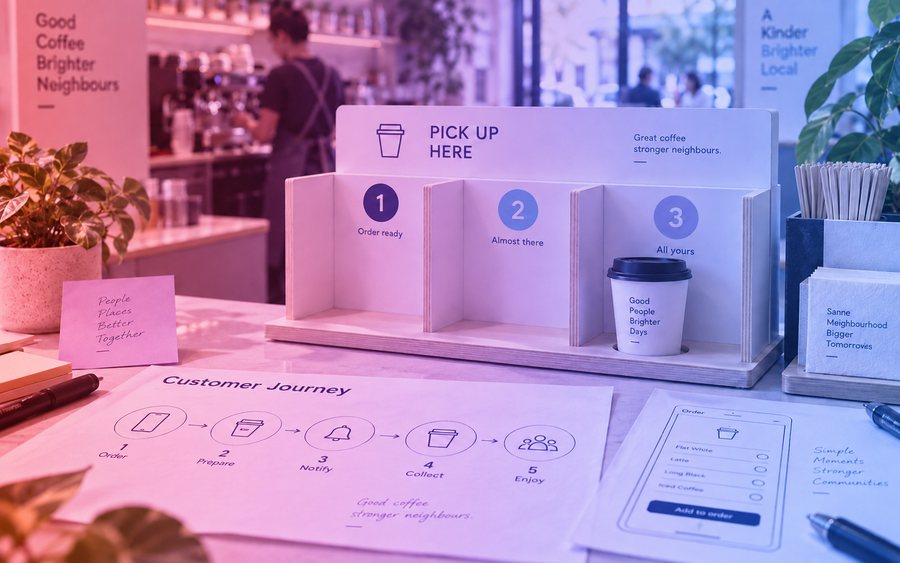
Run a real school business — market and sell to real customers, then analyse how it performed.

10 weeks30 lessons15–16 ages4 checkpoints
Open for Business
At a glance

What students make, learn and show.

01

What they make

A real school business, planned, marketed and traded with real customers, then analysed on its results.

02

What they learn

  • Plan and market a real business to real customers.
  • Apply pricing, costs, revenue, profit and break-even.
  • Trade for real, then analyse the results.
03

How it ends

A Trading Review: teams present how the business traded, with pricing, costs, revenue, profit and break-even.

The ten-week plan

Week by week.

Three 50-minute lessons a week. Checkpoints at weeks 2, 4, 6 and 8 keep every team on track; the teacher guide gives each lesson a starter, a main activity and a plenary.

Weeks 1–2
Discover
Spot and frame the opportunity. Teams research the audience, problem or market behind Open for Business, agree what they are solving and for whom, and set team roles.
Checkpoint 1 · opportunity statement
Weeks 3–4
Design
Turn the opportunity into a concept and a plan: generate and compare options, choose one, and plan how it will be built and tested.
Checkpoint 2 · concept and plan
Weeks 5–6
Make
Create the real deliverable: the product, venture or campaign. Test it against the brief and fix what fails.
Checkpoint 3 · working deliverable
Weeks 7–8
Test & refine
Trial it with real people, gather the evidence (user validation, results, trading figures, reach or impact data) and improve the work from what the evidence says.
Checkpoint 4 · real-world evidence
Week 9
Pitch
Craft and rehearse a persuasive pitch with Q&A: the problem, the solution, the evidence and what happens next.
Pitch rehearsal with feedback
Week 10
Showcase
A Trading Review: teams present how the business traded, with pricing, costs, revenue, profit and break-even. Individual project journal reflection completes the assessment evidence.
Showcase · assessment submitted

Lesson-by-lesson sequence illustrative, from the programme arc, until the teacher guide is supplied.

Lesson preview

See one lesson in full.

Every lesson in the teacher guide follows the same shape: what students should be able to do by the end, a starter, a main activity, a plenary, and the resources to run it. This one is open to everyone.

Request trial access to open the full lesson →

Week 2 · Lesson 4Is this worth solving? Framing the opportunity
By the end, students canState the problem their project will solve, who has it, and one piece of evidence that it is real, in a single opportunity statement.
Starter · 10 minThree opportunity statements from past projects, one weak. Teams pick the weak one and say why.
Main · 30 minTeams turn their research into a draft opportunity statement using the framing sheet, test it against the five-question checklist, and revise it once.
Plenary · 10 minEach team reads its statement aloud; the class asks the one question the team cannot yet answer. Recorded in the project journal.
ResourcesSlides · framing sheet · five-question checklist · journal prompt · teacher notes
Assessment

Four parts. Same model every project.

Each part has its own criteria and rubric in the teacher guide. Judge students at each checkpoint and at the showcase on the tracker, so the evidence is complete when the project ends.

35%
Real deliverable
The product, venture, solution or campaign itself: does it do what it set out to do, for the people it was made for?
25%
Pitch + Q&A
The showcase pitch or demo to an audience or panel, including handling questions with composure.
20%
Real-world evidence
Proof it works with real people: user validation, pilot results, trading figures, reach and impact data.
20%
Project journal
Reflection and process across the project: how students thought, adapted and grew.
Rubric, criteria, checkpoint tasks and the class tracker are in the teacher pack, mapped to the frameworks you report against.How assessment works on Campus →
In the teacher pack
  • Teacher guide: 30 lesson plans with starter, main and plenary
  • Lesson slides, ready to present
  • Student materials and checkpoint tasks
  • Assessment rubric, criteria and checkpoint tracker
  • Partner and audience brief templates, consent forms
  • Showcase running order and audience guide
Standards & streams
Secondary SubjectMapped to EntreComp (EU), CEE (US) and ACARA v9 (Australia). Criterion references to follow
CambridgeAdapted to Cambridge Global Perspectives
IBAdapted to IB MYP Design

Full curriculum alignment →

Responsible AI & data

Students use educator-approved AI tools only. No identifiable personal data about participants is entered into AI tools; consent is obtained for research and publication; AI assistance is recorded alongside students’ own decisions. The teacher guide sets out the tool-approval and data rules for this project.

Teach this project

Start with a free trial.

A 7-day free trial opens one full project for the year group you teach, on screen, and lets you browse the rest, including Open for Business. A Teacher licence unlocks the downloads: $179 a year for all four year groups, or $17.99 a month for the year group you teach. Next term’s project opens four weeks early so you can plan.

Start a free trial
Book a demo

A school email address is required to register.
Related projects

Where this project leads.

Browse all 32 projects →